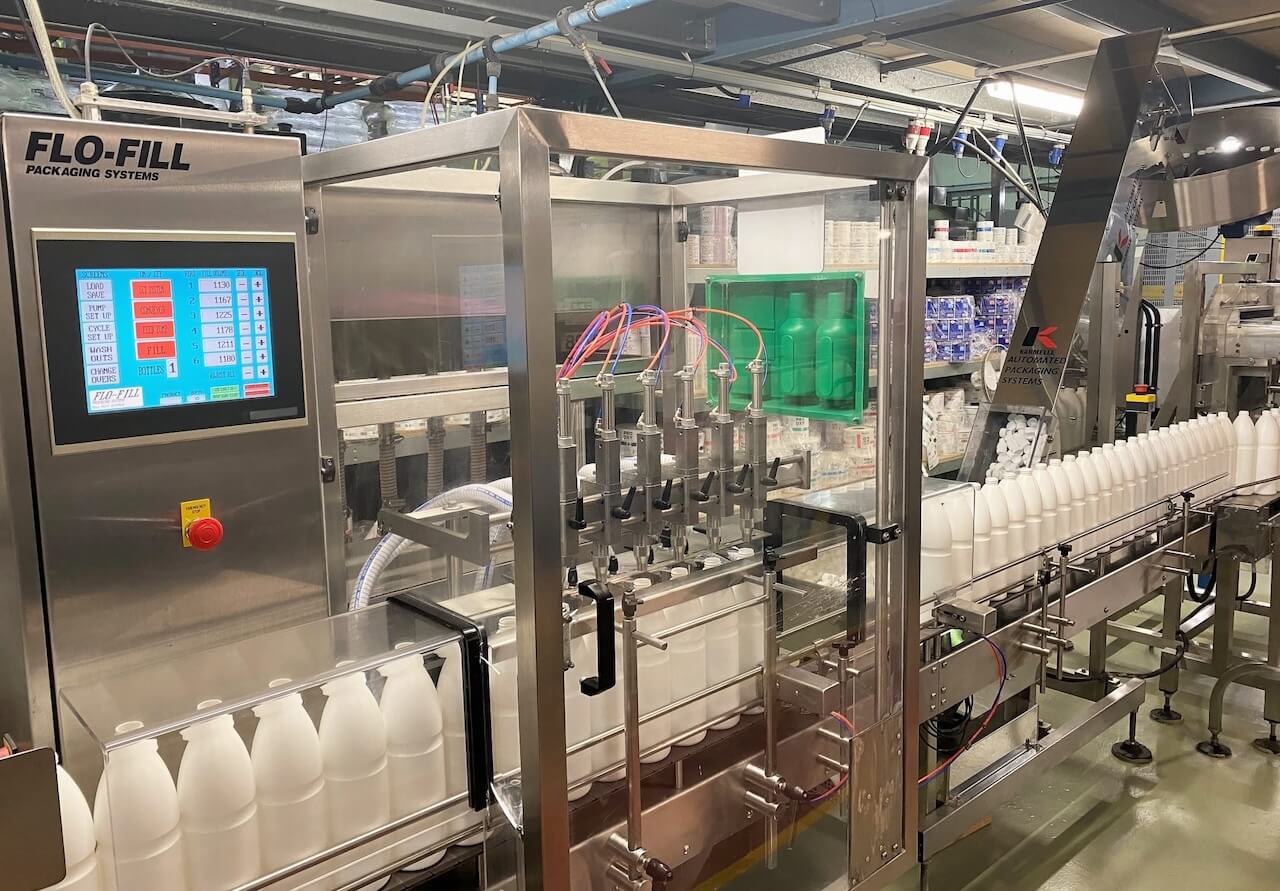
Tricogen manufactures a wide range of peroxide, haircare, cosmetic, and personal care products for both professional and retail markets. It operates a manufacturing and production facility in Newton Aycliffe, County Durham, with the capacity to produce up to 6 million bottles per year.
Production planning runs on a cloud MRP system and a set of sophisticated Excel spreadsheets.
The planning process is a complex operation that must balance a number of factors, including material availability, tank and batch storage capacity, changeovers, labour availability, and customer due dates.
Given the complexity of the existing calculation system, ongoing management, review, and execution are required to maintain an optimal manufacturing schedule. To reflect the latest factory flows, stock levels, and demand, the Excel sheets are managed by the experienced production planning specialist and recalculated every week.
The current combined planning system involving an MRP and Excel, leaning on the planner’s experience and operational knowledge of the plant, has supported the business growth for years.
However, checking a schedule against material stock, capacity, and staffing is manual work rather than something the system does on its own, and cannot be automated at the current state.
The complexity of coordinating bulk manufacture, intermediate storage, filling operations, labour resources, raw material availability, and customer demand across multiple product categories is growing rapidly.
The company decided to improve the efficiency of the planning and scheduling process to support decision-making, growth, and production ramp-ups.
Working with VirtusLab, Tricogen has completed the first phase of a Nexelem APS implementation: a working prototype that proves the MRP integration and the scheduling logic before the full system gets built.
Contents:
Tricogen and the scale of the planning challenge
- Company: Tricogen (Tricogen Laboratories Ltd), a UK manufacturer of peroxide, haircare, cosmetic, and personal care products for professional and retail markets, based in Newton Aycliffe, County Durham, UK.
- Scope: a Nexelem APS prototype and interface design connected to a working copy of Tricogen’s cloud-based MRP system.
- Problem: production schedules assembled by hand across several weekly spreadsheets, with material availability and capacity checked manually rather than in one live view.
- Solution, phase one: a proof of concept plus a Figma-based interface design, confirming that work orders, recipes and due dates can move automatically between the MRP system and Nexelem.
- Status: Integration feasibility confirmed; phase two, the full APS build, is planned as the next stage.
Tricogen runs a two-stage production model: bulk manufacture of a base or batch, followed by mixing, bottling and filling. Across all filling and finishing lines, overall manufacturing capacity runs to roughly 130,000 units a week, and each product family, peroxides, creams, lotions, styling products, needs its own tank or batch storage between the two stages.
Planning runs on a 12-week rolling schedule plus a further six-week “pipeline” view. None of that is unusual for a chemical and cosmetics manufacturer. What makes it demanding is complexity; how much has to be coordinated at once, and across several product categories: bulk manufacture and the intermediate storage it needs, filling operations, raw material availability, labour and the skills on shift, changeover time between products, and customer demand that has to be met whatever the rest of the picture looks like. Each of those moves independently of the others. Holding them in balance, week after week and at the level of detail a plant like this runs on, is exactly the problem APS technology is built to solve.
The planning process today: manual, experienced and time-consuming
No single constraint governs Tricogen’s week. The lines can run around the clock, so labour availability and skills matter a great deal, but so do material availability, tank and batch storage between bulk manufacture and filling, changeover time, and the customer due dates every schedule has to hit. A sequence that suits one of those can create a problem in another, which is why so much of the plan rests on the planning specialist’s experience and operational knowledge.
That knowledge is applied through spreadsheets: one per week for the schedule, plus a separate one tracking work order durations, with similar orders grouped by hand to keep changeovers down. The cloud MRP generates its own output, used as a cross-check rather than the base for planning, and demand is built from the schedule and then verified against the warehouse manually.
The approach has supported the business for many years, and orders ship. What it costs is time and visibility. Every cross-check is a manual one: whether materials will be on site when a batch is due, whether the people rostered for a shift hold the skills the job needs, whether resequencing to save a changeover creates a storage clash further down the line. Larger changeovers are generally scheduled for Fridays, which gives the week a natural buffer. The limit is not the quality of the decisions, it is how long they take to make and how much has to be redone by hand when something moves. That is the gap phase two is meant to close: the same expertise, applied to a schedule that arrives already checked against live data.
Phase one: proving the integration before building the whole system
Rather than committing straight to a full build, Tricogen and VirtusLab agreed to validate the riskiest part of the project first: whether Nexelem could reliably talk to Tricogen’s cloud-based MRP system, one whose internals sit outside Nexelem’s control. The integration method settled on during this phase is a data warehouse layer built from SQL queries against the MRP database. Those views refresh on demand, get exposed through a dedicated API secured with a key, and a small connector application calls that API to move data into an external schema, which Nexelem then imports. The API stays disabled outside of these refresh windows, keeping the exposure small.
Alongside the technical proof of concept, Tricogen’s planner worked through a Figma board of the future Nexelem interface: the dual view of a detailed Gantt chart and a week-by-week summary that the finished system will use, before either was actually coded. That let change requests surface as sketches rather than as rework after launch, which matters more than it sounds like it should on a project where the planner’s day-to-day workflow is the thing being redesigned.
What phase one delivered
The result of this first stage was not a live production schedule; it was proof that the harder assumptions underneath the project hold up.
- Work orders, recipes (BOMs) and due dates moved from the MRP into a working Nexelem prototype without manual re-entry, end to end.
- The chosen integration method, on-demand SQL views behind a secured API, matched Tricogen’s existing IT setup and security posture rather than requiring a new one.
- The Figma interface work gave Tricogen’s planner a concrete look at the dual Gantt and week-by-week summary views before development started on the full system, and produced a specific customization list for phase two: per-workstation targets, a bill of materials view flagging warehouse shortages, and the ability to add manual comments directly on the Gantt chart.
Tricogen’s Managing Director summed up the collaboration this way:
“Throughout our interactions, the VirtusLab team demonstrated a high level of professionalism, technical expertise, and responsiveness. They took the time to understand our business requirements and operational challenges, ensuring discussions remained focused on practical solutions and achievable outcomes. […] We found VirtusLab to be a knowledgeable, capable, and professional organisation that values long-term customer relationships and works constructively to deliver value.” — Managing Director, Tricogen
Looking ahead: what phase two will bring
Phase one answered whether the integration would work. Phase two is where the planning itself becomes automated.
Once complete, Nexelem will pull work orders, recipes, due dates and material availability from the MRP and calculate an optimized schedule that weighs labour availability, material availability and production capacity before a plan reaches the planner’s screen. Setup time starts with a simple default of thirty minutes per changeover, treated as a zero-quantity task with its own slot, with a full changeover matrix planned as a later refinement once enough real setup data has been collected.
The planner will still review and approve every schedule, on the same Gantt chart and week-by-week view validated during the Figma stage, but with material shortages and capacity conflicts flagged up front rather than found later in the week. Approved schedules will sync back to the MRP system automatically, closing the loop that today still runs through manual date updates. Tricogen will also get what-if scenario planning, so a rush order or a machine issue can be tested against the live schedule before anyone commits to it, rather than firefighting a disrupted plan after the fact.
If your own planning team is coordinating a schedule across separate spreadsheets and an MRP export, Tricogen’s phase one shows a way to test the riskiest assumptions first. You can look at how Nexelem’s APS handles constraint-based scheduling, or get in touch to talk through what a similar proof of concept would look like for your own MRP setup.
Last Updated: 25.09.2026