Use the OEE calculator to calculate the OEE for your production.

Overall Equipment Effectiveness (OEE) is a metric used to measure the efficiency of machine utilisation. It combines three factors: availability, productivity and production quality. If your MES system does not automatically calculate OEE based on machine data and production reports, you can use our OEE calculator instead.

What is OEE and how to calculate it? Blog post cover

Calculate your production’s OEE.

See how the Nexelem MES works.

Nexelem MES is a production management system that enables you to identify actual production costs and KPIs, such as OEE, which are calculated in real time. See how Nexelem works. Book a demo or a short, free consultation.

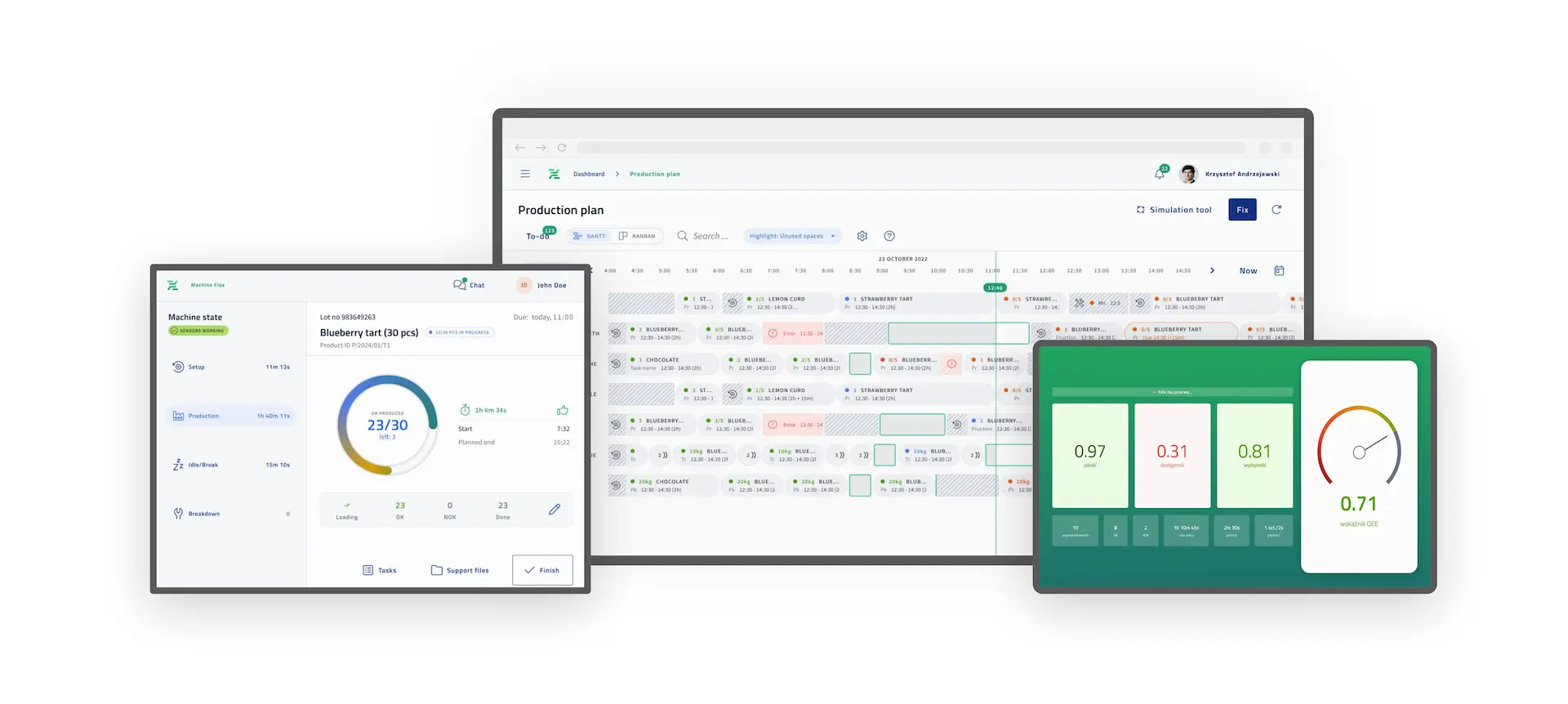
Screenshots of different elements of the Nexelem APS suite

Frequently asked questions about OEE

OEE alone does not explain why the result is higher or lower. This could be due to longer downtimes, more frequent micro-downtimes, a lower production rate, or a higher number of defects, for example. Therefore, it is worth analysing OEE alongside the causes of losses. Only then will the indicator help identify areas for improvement.
Although they can be calculated at various levels, it is important to maintain consistent calculation methods. At the machine level, OEE helps to identify the specific sources of loss. At the line level, it shows the efficiency of the entire process. Aggregating OEE figures for the whole factory can help to assess overall efficiency, but this does not replace the analysis of individual workstations. In practice, the greatest value lies in the ability to drill down from the overall production result to a specific machine, shift, or cause of loss.
If OEE is being used for production management, it is worth analysing the data as close to real time as possible. A weekly report may reveal that a problem has arisen. However, data available during production enables a quicker response before the problem recurs during the next shift. Therefore, it is not just a question of what OEE has been achieved, but also when and why it began to fall.
Yes. Data can be collected either directly from machines and equipment or entered by operators. Depending on the factory’s equipment, a combination of both methods is possible. The system can then automatically calculate the OEE and update the result, eliminating the need to transcribe the data into Excel. See what the data looks like in the Nexelem MES system.
Not always. A dedicated OEE monitoring solution will suffice if you only need a simple measurement of a single parameter. However, MES makes sense when you want to link OEE to the broader picture of production, including order fulfilment, operator performance, downtime, shortages, production reporting and traceability. In that case, OEE becomes part of the production management system rather than a separate report.
Automated OEE reduces the amount of manual work involved in collecting and transcribing data. More importantly, it enables you to link the metric to operational data. This allows you to see not only that OEE has fallen, but also which machine had a problem, when it happened, how long the downtime lasted for, what caused it, how much production was lost and the impact of shortages or a drop in productivity. This means that OEE can be used not only for reporting, but also for day-to-day decision-making on the production floor.
No, an MES can integrate with an existing ERP system. The ERP system can continue to handle areas such as procurement, materials and finance, while the MES system supports the day-to-day management of production and the collection of shop floor data. Integrating the two systems is essential to avoid manual re-entry of information.
Yes, absolutely. Not every factory needs to implement the entire MES system immediately. You can start by addressing a specific issue, such as automatically collecting production data and monitoring OEE, and then expand the solution to cover other areas. This approach enables you to assess the value of the solution for a specific process before changing the entire organisation.
The OEE figure itself is merely the starting point for the analysis. The next step is to identify the main causes of loss, such as downtime, micro-downtime, productivity drops and shortages. It is then worth checking which of these occur most frequently and result in the greatest loss of production time. If you currently calculate OEE manually, start by asking yourself how long it takes to collect the data needed for a single reliable report. If the answer is ‘a few hours’, perhaps the problem lies in the way you collect production data rather than in the OEE calculation itself. Find out how OEE monitoring can work automatically in your factory.

Now you’ve calculated your OEE, what’s next?

If you already calculate Overall Equipment Effectiveness (OEE) on a regular basis, the next step could be to automate the collection of production data. If your company is considering implementing an MES system, please contact us to find out how OEE monitoring works within the Nexelem MES.

Contact form

"*" indicates required fields

This field is for validation purposes and should be left unchanged.
If you click the “Send message” button you agree to the privacy policy. Your personal data given in the contact form above will be processed for purposes of answering your inquiry and for any further correspondence regarding this inquiry. The controller of your personal data is VirtusLab Sp. z o.o. For more information, see our Privacy Policy
This field is hidden when viewing the form

We usually reply within one business day.

Discover our solution