Full Traceability: How to Prepare Your Production for Strict Audit Requirements

Regulators arrive without notice. When auditors request the origin of a raw material batch, its processing conditions, and the operators involved, you must provide that information immediately. In food, pharma, and automotive production, traceability ensures compliance, and the margin for error is nearly zero.
Table of Contents:
- What Does Manufacturing Traceability Cover?
- The Pressure Facing Regulated Industries
- Why Paper Records Fail Under Audit Conditions
- How an MES Supports Manufacturing Traceability
- Building a Traceability Process That Scales
What Does Manufacturing Traceability Cover?
Manufacturing traceability is the ability to track and document a product’s history across every stage of production, from incoming raw materials to finished goods leaving the warehouse. It captures who did what, when, with which materials, and under which conditions.
A complete traceability record connects batch numbers, supplier data, machine parameters, quality checks, and operator IDs into a single chain of evidence. Regulators, customers, and certification bodies require this chain. If any link is missing, the audit fails.
The Pressure Facing Regulated Industries
Food manufacturers operate under frameworks like FSMA and GFSI that require full chain-of-custody documentation at every production step. Pharmaceutical producers face FDA 21 CFR Part 11 and EU GMP requirements demanding electronic records and audit trails. Automotive suppliers must satisfy IATF 16949 and customer-specific quality standards that trace components back to raw material origin.
All these regulations require verified compliance, not self-reporting. Auditors expect documentary evidence, not assurances. Reviews are now more frequent and thorough, with increased penalties for missing information.
Why Paper Records Fail Under Audit Conditions
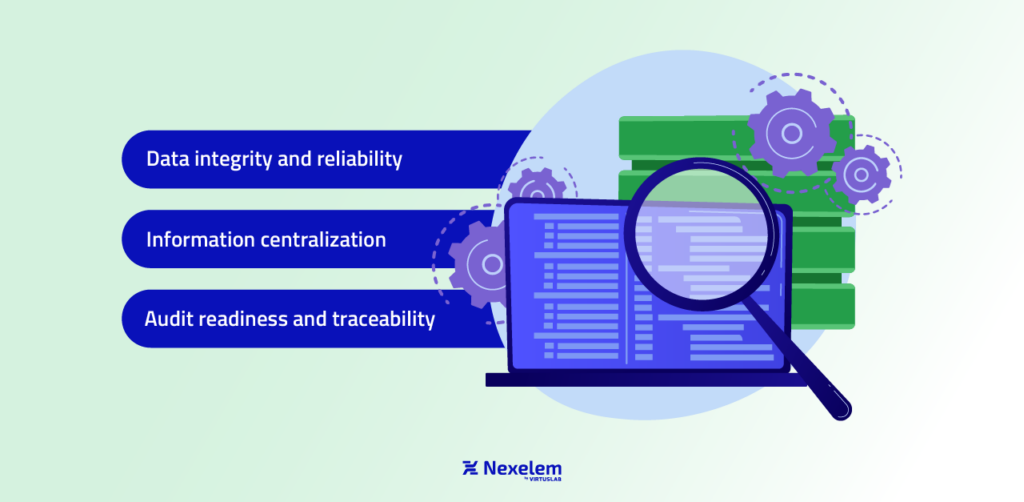
Production environments that rely on paper or spreadsheets face recurring issues under audit pressure: incomplete records, illegible handwriting, retroactive timestamps, and files scattered across departments, with no central view.
Paper records are physically fragile and can be lost, damaged, or misfiled. Reconstructing batch history from old paperwork during a recall or investigation is slow, error-prone, and often inconclusive, leading to compliance failures.
How an MES Supports Manufacturing Traceability
A Manufacturing Execution System captures production data automatically as operations happen, eliminating the manual logging step where most errors and omissions occur. Every scan, every parameter reading, and every quality check is recorded in real time with a timestamp and operator attribution.
Nexelem MES links material tracking with process data, allowing you to generate a complete traceability report for any batch in moments. The report includes inbound material lots, machine conditions, quality decisions, and final output, providing the audit trail regulators require, ready for immediate review.
Building a Traceability Process That Scales
Begin with processes that present the highest regulatory or quality risk. Map your current data capture points, identify the gaps, then implement digital tracking at those points first and expand across the production flow from there.
Consistency matters more than completeness at the start. A system that reliably captures 80% of critical data is easier to defend than a perfect plan that never gets implemented.
To see how Nexelem’s Manufacturing Execution Software supports full traceability in regulated production, request a demo, and we’ll walk through your specific audit requirements together.